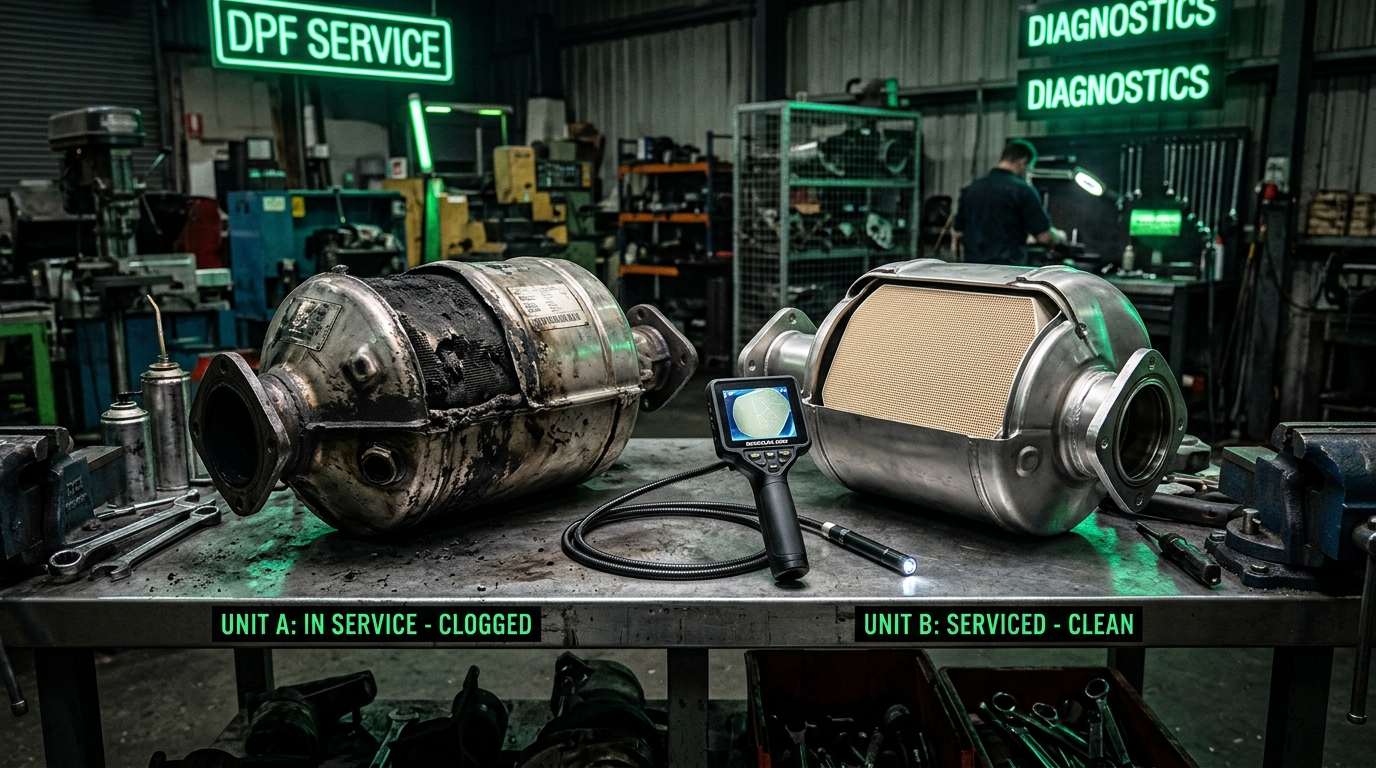
When faced with an aftertreatment fault code or an engine derate, commercial truck owners, fleet operators, and maintenance directors are immediately confronted with a major financial decision: should they pay for professional workshop DPF cleaning, or is complete canister replacement unavoidable? With OEM replacement assemblies costing upwards of thousands of dollars, making the wrong choice can decimate maintenance budgets.
1. The Financial Reality: Cleaning vs. Replacement Costs
The cost difference between professional aftertreatment restoration and brand-new OEM replacement is dramatic:
- OEM Replacement Canister: $3,500 – $9,000+ CAD A factory replacement DPF from Detroit Diesel, Cummins, Volvo, or PACCAR dealership networks typically ranges from $3,500 to over $9,000 CAD depending on engine platform, plus core deposit charges, freight surcharges, and dealership installation labor. In multi-stage canisters like the Detroit DD15 "1-Box", replacing damaged aftertreatment modules can exceed $12,000 CAD.
- Professional Workshop Restoration: $350 – $800 CAD Comprehensive off-vehicle pneumatic pulse cleaning, high-temperature thermal kiln baking, and flow bench certification at our Kitchener facility costs a small fraction of a new unit while recovering 95% to 98% of original factory airflow capacity.
For an owner-operator running a single power unit, choosing scheduled cleaning over premature replacement preserves thousands of dollars in capital. For a logistics fleet running 20 to 50 power units across Ontario, a systematic DPF cleaning schedule saves over $100,000 annually in fleet maintenance expenditure.
2. When Professional Cleaning Works Perfectly
More than 90% of restricted filters brought to our Kitchener workshop are prime candidates for complete restoration. Professional cleaning is effective and recommended whenever:
- Routine Ash Compaction: The filter has accumulated 250,000 to 400,000 kilometres of normal engine operation, and non-combustible metallic ash has restricted channel volume.
- Soot Loading from Upstream Faults: The filter is choked with carbon soot due to a failed turbo boost hose, sticking EGR valve, or faulty hydrocarbon doser that has since been repaired.
- Intact Substrate Honeycomb: Optical pin-testing and borescopic examination confirm that internal ceramic walls are structurally intact with no signs of melting, thermal sintering, or cellular cracks.
3. Physical Inspection Benchmarks: How Technicians Verify Core Viability
Before proceeding with thermal baking or pneumatic de-ashing at JTECH DPF, every filter undergoes a non-destructive physical screening process:
- The 1.0mm Tungsten Pin Depth Test: Technicians insert a calibrated, rounded wire probe into select sample channels across the face. On an intact filter, the pin stops firmly at the uniform depth of the rear plug. If the pin penetrates beyond the plug or drops freely, internal cell walls have melted or fractured, indicating core failure.
- High-Intensity Backlight Transmission: By directing powerful LED array light into the outlet face while observing the inlet, technicians look for direct pinpoints of light. Because channels are staggered with end-plugs, zero direct light should transmit through an intact wall-flow monolith. Direct light transmission reveals fractured or blown-out channel walls.
- Pre-Cleaning Differential Pressure Benchmarking: Measuring baseline air resistance in CFM confirms whether restriction is caused by dry particulate or dense liquid oil contamination.
4. When Replacement Is Mandatory: Transparent Diagnosis
At JTECH DPF, we maintain an uncompromising commitment to honest engineering: we will never sell a cleaning if a filter is mechanically destroyed. In certain failure modes, ceramic monoliths suffer irreparable structural degradation that no cleaning process can reverse:
- Thermal Runaway & Substrate Melting: When excessive unburned fuel or engine oil enters an ash-blocked filter during active regeneration, core temperatures can spike above 1,100°C. This melts the ceramic wall structure into solid glass-like slag, permanently closing channels.
- Internal Substrate Fractures & Blow-By: Thermal shock (such as splashing cold water onto an overheated canister or severe mechanical road strikes) can crack the ceramic monolith longitudinally. When this occurs, unfiltered black soot blows straight through the cracks into the tailpipe—failing Ministry of Transportation emissions audits.
- Severe Oil Saturation and Cell Glazing: When a turbocharger seal fails catastrophically and dumps gallons of raw engine oil into the exhaust stream, the oil soaks deep into the porous ceramic cell walls. While moderate oil contamination can often be baked out in our thermal kilns, extreme oil saturation can glaze cell walls permanently.
5. The Pitfalls of Cheap Aftermarket Replacements
When faced with high OEM prices, some operators turn to budget aftermarket DPFs sourced online. However, independent testing consistently reveals significant drawbacks:
Many cheap aftermarket filters feature inferior cordierite substrates with lower cell density and inadequate precious metal (platinum/palladium) washcoat loadings. As a result, they produce higher baseline backpressure, suffer reduced passive regeneration efficiency, and trigger recurring ECM fault codes. Restoring your genuine OEM canister via certified workshop cleaning is almost always technologically superior to installing a low-grade aftermarket clone.
Frequently Asked Questions
How many times can a heavy-duty DPF be professionally cleaned?
A high-quality OEM silicon carbide or cordierite filter can typically be cleaned 3 to 5 times over its service life—equating to 1,000,000+ kilometres of commercial operation—provided the substrate is never melted by thermal runaway or cracked by physical impact.
How do I know if my DPF is cracked before removing it?
The easiest pre-check is the "white rag test." Wipe the inside of your exhaust tailpipe with a clean white cloth. On a modern diesel truck with an intact DPF, the rag should remain virtually clean. If the rag comes away heavily coated in velvety black soot, the filter substrate is cracked or failing internal plugs, allowing soot blow-by.
What documentation does JTECH DPF provide with cleaning?
Every filter restored at our Kitchener facility receives a comprehensive test certificate detailing pre-cleaning weight, post-cleaning weight, differential pressure drop across the canister, and verified airflow in CFM against OEM benchmarks.
Get an Honest DPF Assessment at JTECH DPF
Do not spend thousands on an unneeded replacement canister before having your filter inspected on our calibrated flow bench. Contact our Kitchener workshop for transparent evaluation and rapid turnaround.
Request Workshop Evaluation →